Quick Answer: A charter school is a publicly funded school that operates independently with more flexibility than traditional public schools.
You may have heard parents, teachers, or news channels talking about charter schools and wondered what makes them different from regular public schools. The term can sound confusing at first because many people are unsure whether charter schools are public, private, or something in between.
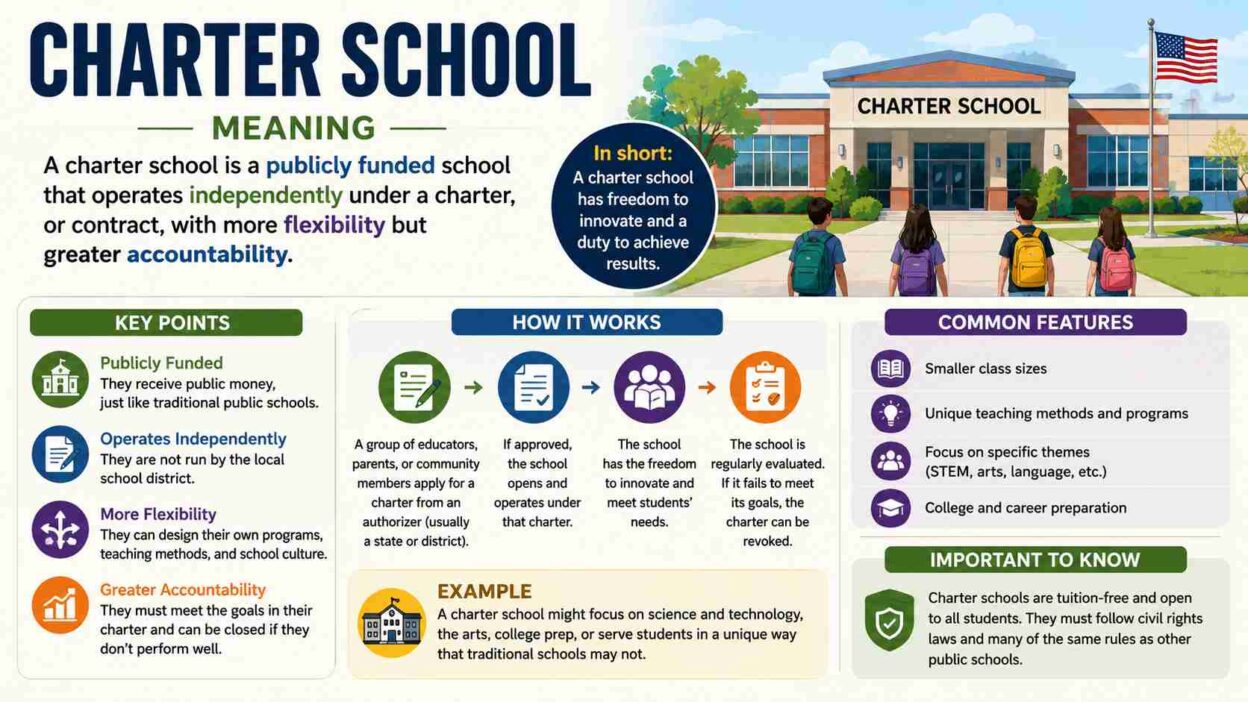
In simple words, charter schools receive public money but have more freedom to create their own teaching styles, programs, and rules.
What Does Charter School Mean?
A charter school is a school that works under a special agreement called a charter. This agreement allows the school to operate independently while still receiving government funding.
Unlike traditional public schools, charter schools often:
- Create unique teaching methods
- Focus on special subjects or learning styles
- Have more control over curriculum and management
However, they must still meet academic standards set by the government or education authorities.
Example sentence:
“My daughter attends a charter school that focuses on science and technology.”
In short:
Charter school = publicly funded independent school = more educational flexibility
Charter School Meaning Table
| School Type | Funding | Control | Tuition |
|---|---|---|---|
| Charter School | Public funds | Independent management | Free |
| Public School | Government funded | Local school district | Free |
| Private School | Private funding | Independent | Paid tuition |
| Homeschool | Family funded | Parents | Varies |
This table helps explain how charter schools fit between traditional public and private education systems.
Where Are Charter Schools Commonly Found?
Charter schools are especially popular in the United States.
You will commonly hear about them in:
- 🏫 Education discussions
- 📰 News reports
- 👨👩👧 Parent communities
- 📚 School choice programs
- 🎓 Academic policy debates
Tone:
- Educational
- Professional
- Informational
- Not slang
Examples of Charter School in Conversation
Here are natural examples of how people use the term:
A: what kind of school does your son go to
B: he goes to a charter school
A: is a charter school private
B: no it’s publicly funded but independently run
A: why do parents choose charter schools
B: many like the smaller classes and special programs
A: do charter schools cost money
B: most are free because they receive public funding
A: are charter schools better
B: it depends on the school and student needs
How Charter Schools Work
Charter schools operate under a contract or charter that outlines:
- Academic goals
- Student performance expectations
- Operational rules
If the school does not meet standards, the charter can sometimes be removed.
Many charter schools focus on:
- Science and technology
- Arts and creativity
- College preparation
- Language immersion
- Specialized teaching methods
When to Use and When Not to Use the Term Charter School
When to Use
- ✅ Talking about education systems
- ✅ Discussing school options
- ✅ Academic or parenting conversations
- ✅ News and policy discussions
When Not to Use
- ❌ Casual slang conversations
- ❌ As a replacement for private school in every case
- ❌ Informal jokes without context
Usage Comparison Table
| Context | Example Phrase | Why It Works |
|---|---|---|
| Parenting Discussion | “we chose a charter school” | Educational context |
| News Report | “charter schools are expanding” | Informational |
| School Research | “compare charter and public schools” | Clear explanation |
| Casual Joke | Not ideal | Too specific |
Similar Education Terms or Alternatives
| Term | Meaning | When to Use |
|---|---|---|
| Public School | Government operated school | General education |
| Private School | Tuition based school | Independent education |
| Magnet School | Specialized public school | Focused programs |
| Homeschool | Parent led education | Home learning |
| Online School | Virtual learning system | Remote education |
Advantages and Disadvantages of Charter Schools
Advantages
- Smaller class sizes in some schools
- Innovative teaching methods
- More educational flexibility
- Specialized programs
Disadvantages
- Quality varies by school
- Limited availability in some areas
- Different rules and policies
- Debate about public funding use
Conclusion
Charter schools are an important part of modern education systems, especially in the United States. They combine public funding with greater independence, allowing schools to try different teaching methods and specialized programs.
While opinions about charter schools vary, understanding what they are helps parents and students make more informed education choices. Whether you are researching schools or simply trying to understand the term, charter schools represent a flexible approach to public education.