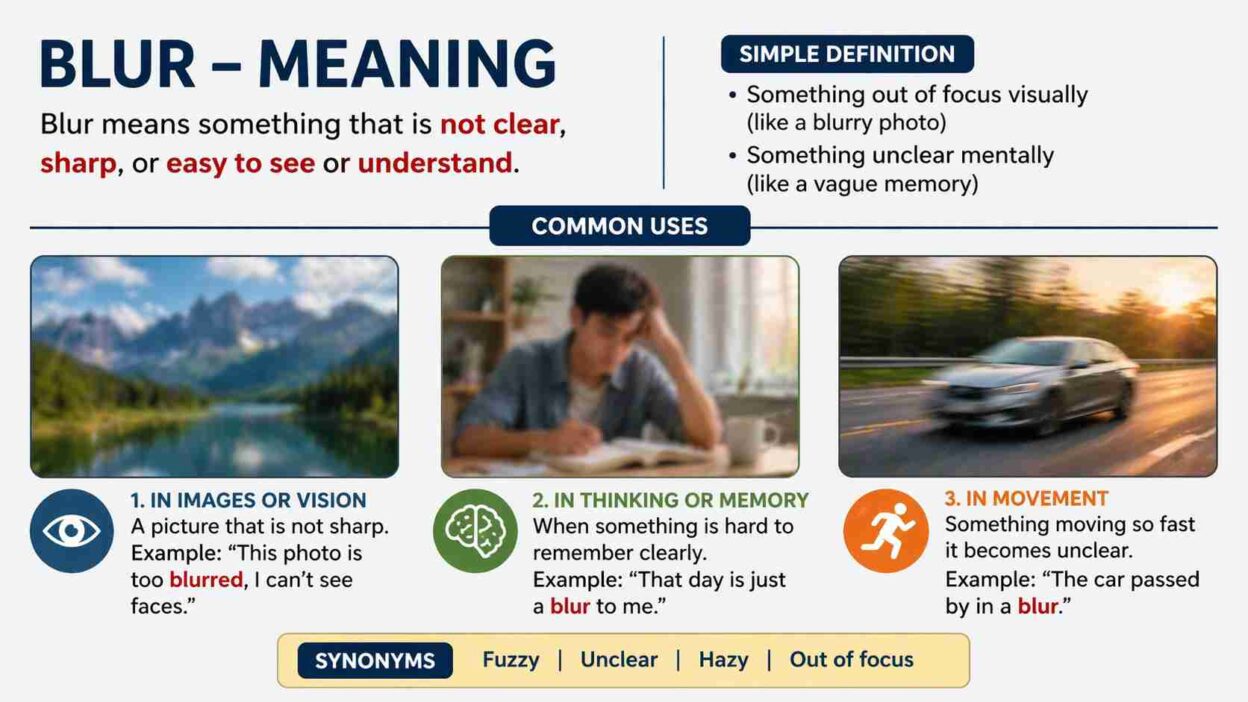
Quick Answer: Blur means something unclear, not sharp, or hard to remember. In text, it is a casual and expressive way to say something feels confusing, fast, or hard to see clearly.
You are scrolling through messages or social media, and suddenly someone says “that’s a blur” or “everything feels like a blur.” At first, it might sound confusing. Are they talking about vision, memory, or something emotional? Many people see this word and are not sure how it is being used in everyday conversations.
What Does Blur Mean in Text?
In texting and social media, blur usually describes something that is unclear, confusing, or not easy to remember.
People use it in two main ways:
- To describe vision or images that are not clear
- To describe memories or events that feel fast or hard to recall
Example sentence:
“last night is a blur 😵”
This means the person cannot clearly remember what happened.
In short:
Blur = unclear or not sharp = confusing or hard to remember
Blur Meaning Table
| Word | Meaning | Usage | Tone |
|---|---|---|---|
| Blur | Not clear or sharp | Memory or vision | Casual |
| Fuzzy | Slightly unclear | Thoughts or memory | Informal |
| Hazy | Not fully clear | Emotions or recall | Casual |
| Vague | Lacking detail | Explanation | Neutral |
Where Is Blur Commonly Used?
You will often see blur used in casual communication.
Common places include:
- 📱 Text messages
- 📸 Instagram captions
- 🎵 TikTok posts
- 💬 WhatsApp chats
- 🎮 Gaming conversations
Tone:
- Casual
- Expressive
- Emotional sometimes
- Not formal
Avoid using it in professional or formal writing.
Examples of Blur in Conversation
Here are real texting style examples:
A: how was the party
B: honestly it’s all a blur 😵
A: do you remember what happened
B: nope total blur
A: my day went by so fast
B: same everything felt like a blur
A: why didn’t you reply yesterday
B: busy day bro just a blur
A: was the movie good
B: yeah but ending was kinda a blur
When to Use and When Not to Use Blur
When to Use
- ✅ Talking about unclear memories
- ✅ Describing fast or busy days
- ✅ Casual conversations
- ✅ Expressing confusion
When Not to Use
- ❌ Formal emails
- ❌ Professional reports
- ❌ Serious explanations
- ❌ Medical diagnosis without clarity
Usage Comparison Table
| Context | Example Phrase | Why It Works |
|---|---|---|
| Friend Chat | “yesterday was a blur 😄” | Casual and relatable |
| Social Media | “life feels like a blur” | Emotional expression |
| Work Chat | “it was a busy day” | Professional tone |
| “the timeline was unclear” | Clear and formal |
Similar Slang Words or Alternatives
| Word | Meaning | When to Use |
|---|---|---|
| Fuzzy | Slightly unclear | Casual chats |
| Hazy | Not clear | Emotional tone |
| Vague | Lacking detail | Neutral use |
| Confusing | Hard to understand | General use |
| Messy | Disorganized | Informal |
FAQs
What does blur mean in text?
It means something unclear, confusing, or hard to remember.
Can blur describe memory?
Yes, people often use it to describe unclear or forgotten memories.
Is blur formal or casual?
It is mostly casual and used in everyday conversations.
Does blur always mean vision?
No, it can also describe emotions, memories, or fast experiences.
Can I use blur in professional writing?
It is better to use clearer words like unclear or vague in formal settings.
Conclusion
Blur is a simple but powerful word used to describe anything that feels unclear, fast, or hard to remember. In texting and social media, it helps express confusion, busy moments, or faded memories in a relatable way.
While it works great in casual conversations, it is best avoided in formal communication. Understanding how to use blur correctly will make your messages more natural and expression.