
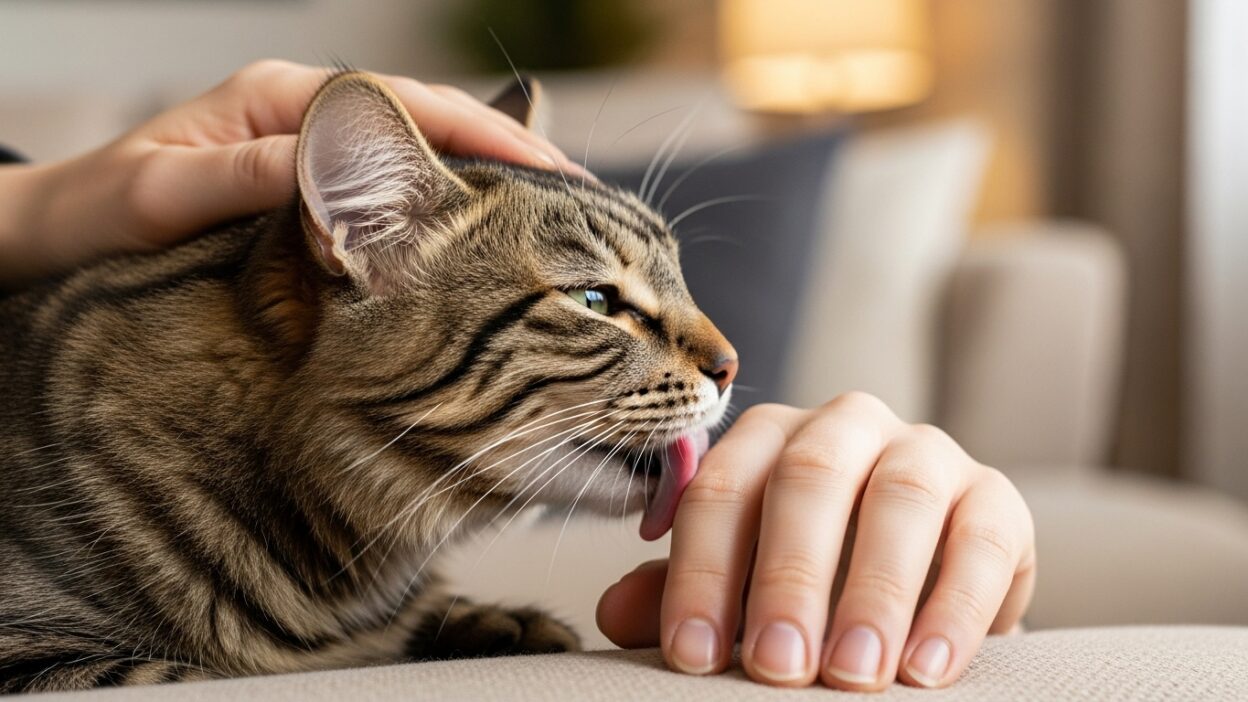
If you’re a cat owner, you’ve probably experienced this moment: you’re sitting quietly, and suddenly your cat starts licking your hand, arm, or even your face. It can feel sweet, confusing, or sometimes a little weird. So what’s really going on?
When a cat licks you, it’s rarely random behavior. In fact, cat licking usually carries emotional, social, or instinctive meaning. Cats use licking as a form of communication, bonding, grooming, and sometimes even stress relief. Understanding why your cat does this can help you better connect with them and respond in the right way.
Let’s break it all down in a simple, friendly way.
When a cat licks you, it usually means affection, trust, bonding, or grooming. In some cases, it can also signal stress, comfort-seeking, or learned behavior.
What Does It Mean When a Cat Licks You?
Cats lick for many reasons, and the meaning depends on the situation, frequency, and your cat’s body language.
At its core, licking is a natural feline behavior tied to grooming and social bonding. Kittens are licked by their mothers from birth, so licking becomes associated with safety, care, and closeness.
When your cat licks you, they may be treating you the same way they would treat another cat they trust.
In short:
Cat licking = affection + comfort + connection.
Your Cat Is Showing Affection ❤️
One of the most common reasons cats lick humans is simple love.
Cats don’t show affection the same way dogs do. Instead of tail-wagging or jumping, they use quieter actions like slow blinking, head bumps, and licking.
If your cat gently licks you while purring or relaxing, it usually means:
- They trust you
- They feel safe with you
- They consider you part of their family
This type of licking is often called “kitty kisses.”
Your Cat Is Grooming You 🧼
In the wild and in multi-cat households, cats groom each other. This behavior is called allogrooming.
When your cat licks you:
- They may be trying to “clean” you
- They see you as part of their social group
- They’re reinforcing bonds
Even though you’re obviously much bigger and not furry, your cat doesn’t mind. To them, grooming equals care.
Your Cat Feels Comfortable and Safe 😌
Cats are cautious animals. They don’t lick just anyone.
Licking often happens when:
- Your cat is calm
- They’re lying next to you
- The environment feels secure
This means your cat feels emotionally relaxed around you. That’s a big compliment in cat language.
Your Cat Is Marking You as “Theirs” 🐾
Cats have scent glands in their mouths and tongues.
When they lick you, they may be:
- Mixing their scent with yours
- Claiming you as part of their territory
- Strengthening familiarity
This doesn’t mean ownership in a negative way. It’s more like saying, “You belong with me.”
Your Cat Is Seeking Attention 👀
Sometimes licking is a strategy.
If your cat has learned that licking gets a reaction petting, talking, or eye contact they may repeat it to grab your attention.
This is especially common if:
- You’re busy or distracted
- Your cat wants food or playtime
- They feel ignored
In these cases, licking is communication, not just affection.
Your Cat Is Stress-Relieving 😿
Licking can also be a self-soothing behavior.
Cats may lick:
- When they’re anxious
- During changes in routine
- If they feel overstimulated
If your cat licks you excessively, especially combined with restlessness or hiding, stress might be the cause.
Your Skin Tastes or Smells Interesting 👃
Believe it or not, cats sometimes lick humans because of taste.
Your skin may have:
- Salt from sweat
- Lotion or soap residue
- Food smells
If licking happens mainly after workouts or showers, curiosity could be the reason.
What If a Cat Licks Then Bites?
This confuses many cat owners.
Usually, licking followed by a bite means:
- Your cat is overstimulated
- They’ve reached their limit
- They want you to stop petting
This is known as “love biting.” The bite is usually gentle but serves as a warning.
Is It Okay to Let Your Cat Lick You?
Generally, yes with moderation.
Pros:
- Strengthens bonding
- Shows trust
- Comforts your cat
Cons:
- Cat tongues are rough
- Excessive licking can irritate skin
- Bacteria may be transferred through open cuts
If you have sensitive skin or wounds, it’s best to gently redirect the behavior.
When Cat Licking Might Be a Problem 🚨
Occasional licking is normal. However, excessive licking may indicate:
- Anxiety
- Boredom
- Medical issues
If your cat suddenly starts licking constantly or obsessively, consider consulting a veterinarian.
Meaning Table: Why Cats Lick Humans
| Behavior | What It Means |
|---|---|
| Gentle licking + purring | Affection and trust |
| Licking hands or face | Grooming behavior |
| Licking then biting | Overstimulation |
| Excessive licking | Stress or anxiety |
| Licking after workouts | Attraction to salt or smell |
FAQs
1. Is it normal for cats to lick their owners?
Yes, it’s completely normal and usually a sign of affection or bonding.
2. Does cat licking mean love?
In most cases, yes. It shows trust, comfort, and emotional connection.
3. Why does my cat lick me before sleeping?
Your cat feels safe and relaxed and may be bonding before rest.
4. Why does my cat lick my face?
Your cat may be grooming you or showing affection, though it’s best to discourage face licking for hygiene reasons.
5. Can cat licking mean stress?
Yes, especially if the licking is excessive or sudden.
Conclusion
When a cat licks you, it’s rarely meaningless. Most of the time, it’s a beautiful sign of affection, trust, and bonding. Your cat may be grooming you, marking you as family, or simply enjoying your presence.
However, context matters. Pay attention to body language, frequency, and changes in behavior. Gentle, occasional licking is a good thing. Excessive licking may be your cat’s way of asking for help or comfort.
Understanding these small actions helps strengthen the bond between you and your feline friend and makes your relationship even more special.