
You often hear the term GDP on the news, in economics classes, or during discussions about a country’s progress. Reporters talk about GDP growth, politicians promise to improve GDP, and economists analyze GDP numbers all the time. Still, for many people, the term feels confusing and technical. You might wonder why it matters so much and what it actually tells us about everyday life.
GDP is used as a simple way to measure how well a country’s economy is doing. It helps compare different countries and track economic changes over time. However, GDP is not just a number for experts. It affects jobs, income levels, government spending, and overall living standards. Understanding what GDP stands for and how it works makes it much easier to follow economic news and decisions that impact society as a whole.
Meaning of GDP
GDP stands for Gross Domestic Product, which means the total value of all goods and services produced within a country during a specific period of time, usually one year.
Meaning Table
| Term | Simple Meaning |
|---|---|
| GDP | Gross Domestic Product |
| Gross | Total value before deductions |
| Domestic | Produced within a country |
| Product | Goods and services |
| Economy | System of production and consumption |
What Is Gross Domestic Product
Gross Domestic Product measures the size and performance of an economy. It adds up everything produced by businesses, government, and individuals within a country’s borders. This includes items you can touch, like cars and food, as well as services, such as healthcare, education, and transportation.
GDP does not count products made outside the country, even if a domestic company owns the factory. It focuses strictly on production that happens inside national borders.
Why GDP Is Important
GDP is important because it gives a snapshot of economic health. When GDP is rising, it usually means businesses are producing more, people are spending more, and jobs are growing. When GDP falls, it can signal economic trouble, such as recessions or slowdowns.
Governments use GDP to plan budgets, set taxes, and decide how much to spend on public services. Investors also look at GDP to decide where to invest money.
How GDP Is Calculated
GDP can be calculated in three main ways, all of which should give the same result.
The production approach adds up the value of all goods and services produced.
The income approach adds up wages, profits, and taxes earned from production.
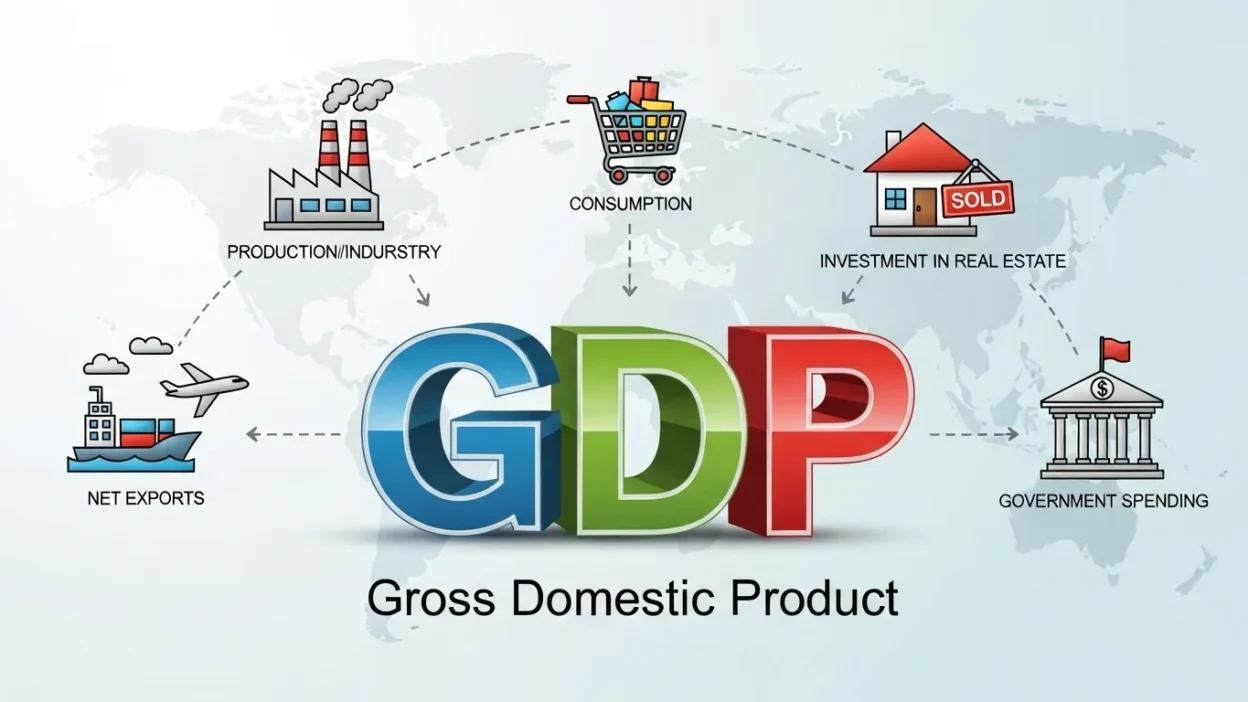
The expenditure approach adds up spending by households, businesses, government, and exports minus imports.
The expenditure approach is the most commonly used and includes consumption, investment, government spending, and net exports.
Types of GDP
There are different types of GDP used to analyze the economy more accurately.
Nominal GDP measures the value of goods and services at current market prices.
Real GDP adjusts for inflation, showing true economic growth.
GDP per capita divides GDP by population, showing average economic output per person.
GDP per capita is often used to compare living standards between countries.
GDP Growth and What It Means
GDP growth refers to the increase in GDP from one period to another. Positive growth usually means the economy is expanding. Negative growth means the economy is shrinking.
Small, steady growth is often seen as healthy, while very fast growth can sometimes lead to inflation. Long periods of negative growth can result in unemployment and reduced incomes.
Examples of GDP in Simple Terms
If a country produces more cars, builds more houses, and provides more services like education and healthcare, its GDP increases.
If factories close, people spend less money, and businesses reduce production, GDP decreases.
In simple words, GDP reflects how active and productive an economy is.
What GDP Does Not Measure
Although GDP is useful, it does not measure everything. It does not show how wealth is distributed among people. A country can have high GDP but still have poverty and inequality.
GDP also does not measure happiness, environmental health, or quality of life. For example, pollution cleanup can increase GDP even though pollution itself is harmful.
GDP and Living Standards
GDP per capita is often linked to living standards, but it is not perfect. Higher GDP per capita usually means better access to education, healthcare, and infrastructure.
However, living standards also depend on income distribution, social services, and cost of living, which GDP alone cannot fully explain.
GDP Compared to Other Economic Indicators
GDP is often used alongside other indicators such as unemployment rate, inflation rate, and poverty levels.
Together, these indicators give a clearer picture of economic health than GDP alone.
How Governments Use GDP
Governments use GDP data to shape economic policy. It helps decide interest rates, taxation policies, and government spending.
International organizations also use GDP to compare economies and provide financial assistance when needed.
Common Misunderstandings About GDP
Many people think GDP measures personal income, but it does not. GDP measures total production, not how much money individuals earn.
Another misunderstanding is that higher GDP always means better life quality. In reality, social and environmental factors also matter.
FAQs
What does GDP stand for?
GDP stands for Gross Domestic Product.
Is GDP measured yearly or monthly?
GDP is usually measured yearly, but quarterly estimates are also common.
Does GDP include services?
Yes, GDP includes both goods and services produced in a country.
Is higher GDP always good?
Higher GDP often indicates growth, but it does not guarantee equal wealth or happiness.
What is GDP per capita?
GDP per capita is GDP divided by population, showing average output per person.
Conclusion
GDP stands for Gross Domestic Product and represents the total value of goods and services produced within a country. It is one of the most widely used indicators to measure economic size and growth.
While GDP helps understand economic performance and guide policy decisions, it does not tell the whole story about living standards or well-being.
Understanding GDP makes it easier to follow economic news and see how national and global economies function.
See Also More :
- What Does Renewed Mean on Amazon? Is It Worth Buying? (2026)
- What Does a High Basophils Mean in a Blood Test? Should You Worry?