
If you’ve ever applied for a loan, credit card, or mortgage, you’ve probably seen the term APR and wondered what it really means. It looks technical, and many people assume it’s just another confusing financial acronym. But understanding APR is actually very important it helps you know how much borrowing money will really cost you.
APR is used in banking, lending, and credit industries worldwide. Once you know what it stands for and how it works, you’ll make smarter financial decisions and avoid surprises when paying back loans.
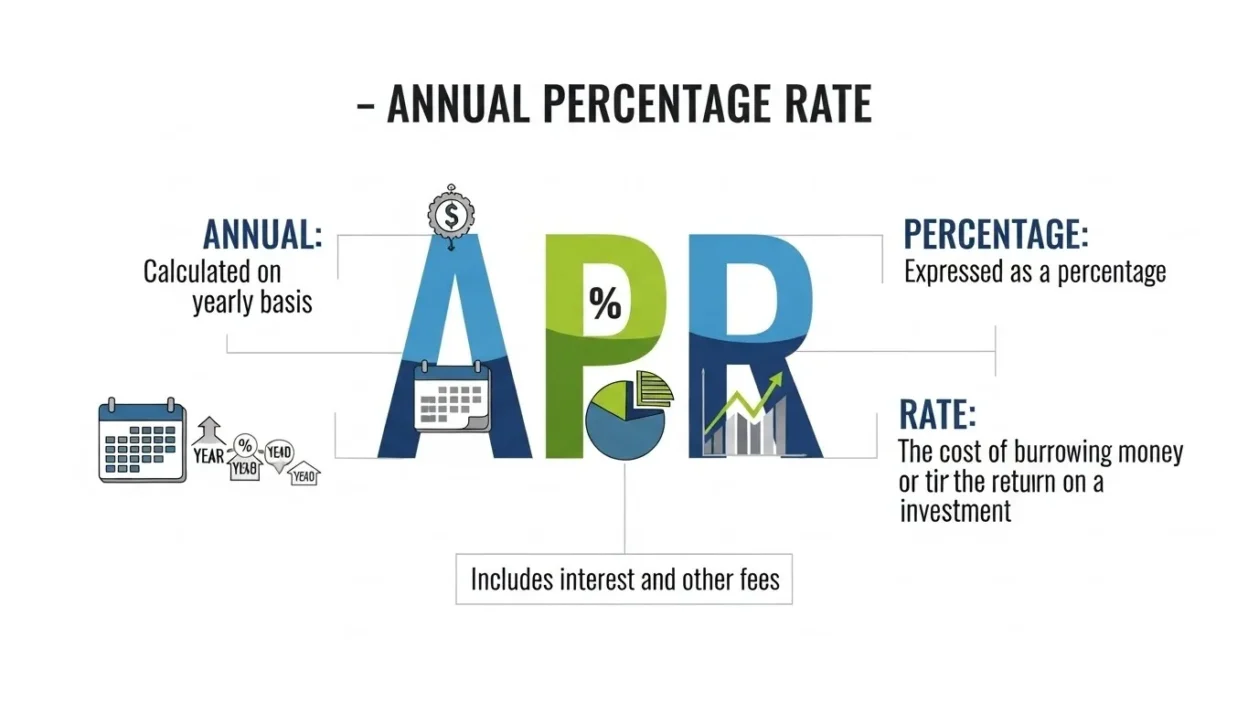
APR stands for Annual Percentage Rate. It is the yearly interest rate charged on loans, credit cards, or other borrowing, including fees, giving you the true cost of borrowing.
🧠 What Does APR Mean?
APR, or Annual Percentage Rate, is the total yearly cost of borrowing money. It includes not only the interest rate but also other fees or costs associated with the loan.
Example:
- You borrow $1,000 with a 5% APR.
- At the end of one year, you pay $50 in interest, plus any included fees.
This makes APR a more accurate way to compare loans than the simple interest rate because it shows the real cost of borrowing.
In short:
APR = Annual Percentage Rate = Total yearly borrowing cost including fees.
📱 Where Is APR Used?
APR is commonly used in financial situations, including:
- Credit cards
- Personal loans
- Mortgages
- Auto loans
- Student loans
- Payday loans
It is formal and professional, often appearing in contracts, banking statements, and financial advertisements.
💬 Examples of APR in Use
Here are some real-world examples:
- A credit card shows APR: 19.99%.
This means if you carry a balance for a year, the total interest plus fees would equal 19.99% of the balance. - A mortgage advertises APR 6.5%.
This includes the interest rate and additional costs like closing fees. - An auto loan has a 5% APR for 60 months.
The APR shows the total annual cost including interest and fees.
Understanding APR helps you compare loans accurately, rather than just looking at the interest rate.
🕓 Why APR Matters
Knowing APR is essential because:
- It reflects the true cost of borrowing
- Helps you compare loan offers
- Prevents being surprised by hidden fees
- Helps in budgeting repayment
- Protects against predatory lending
Without considering APR, you might choose a loan that seems cheap but is actually expensive once fees are included.
🔄 Types of APR
There are different types of APR depending on the financial product:
1. Fixed APR:
Stays the same for the life of the loan. Your payments are predictable.
2. Variable APR:
Can change over time depending on market rates or a benchmark like the prime rate.
3. Promotional APR:
Often used in credit cards as a low or 0% rate for a limited period.
🌟 Tips to Keep in Mind
- Always check APR, not just the interest rate.
- Compare loans using APR to find the cheapest option.
- Watch for hidden fees that might raise the APR.
- Understand that higher APR = higher borrowing cost.
❓ FAQs
What does APR stand for?
APR stands for Annual Percentage Rate. It represents the total yearly cost of borrowing, including interest and fees.
Is APR the same as interest rate?
Not always. Interest rate shows only the cost of borrowing money, while APR includes fees, giving a complete picture.
Why is APR important?
APR helps you compare loans accurately, showing the real cost of borrowing money, including hidden fees.
What is a good APR?
A lower APR is better because it means you’ll pay less interest and fees over time.
Can APR change?
Yes, variable APR can change over time. Fixed APR stays the same for the life of the loan.
Where do I see APR?
APR is usually listed in loan agreements, credit card offers, and mortgage statements.
🏁 Conclusion
APR, or Annual Percentage Rate, is a crucial financial term that shows the true cost of borrowing money. Unlike simple interest, APR includes fees and other charges, making it easier to compare loans, credit cards, and other financial products.
you are buying a car, taking a mortgage, or using a credit card, understanding APR ensures you know exactly how much you’ll pay over time. Knowing your APR helps you make informed decisions and avoid surprises in your financial life.