
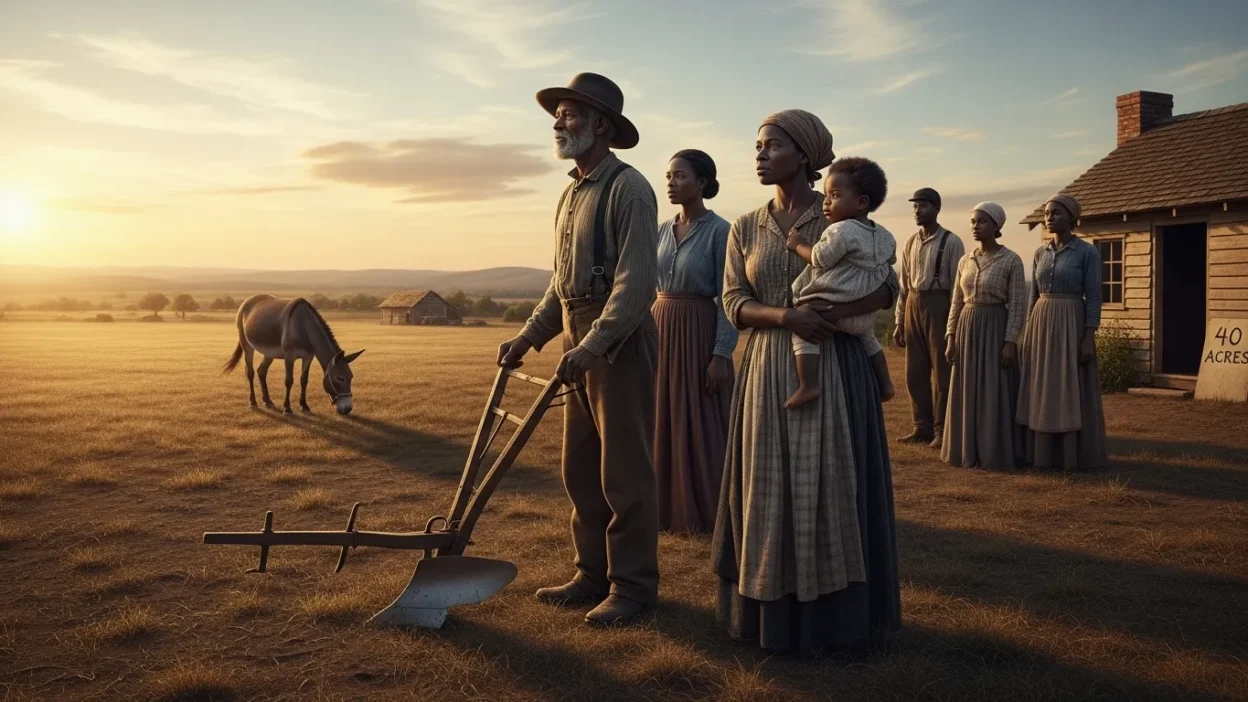
“40 acres and a mule” refers to a promise made by the U.S. government in 1865 to give formerly enslaved African Americans land (40 acres) and resources (a mule) to help them achieve economic independence after slavery.
You may have heard the phrase “40 acres and a mule” in history class, a movie, a rap lyric, or a heated political discussion—and wondered what it really means. At first glance, it sounds literal and oddly specific. Why 40 acres? Why a mule? And why does a phrase from the 1860s still matter today?
The answer sits at the crossroads of American history, racial justice, economics, and modern cultural conversation. “40 acres and a mule” began as a post–Civil War policy idea meant to help formerly enslaved people start new lives. Over time, it evolved into a powerful shorthand for unfulfilled promises and ongoing debates about reparations.
What Does “40 Acres and a Mule” Mean?
At its core, “40 acres and a mule” means land ownership and economic opportunity promised—but denied—to formerly enslaved African Americans after the Civil War.
It represents:
- A historical promise of restitution
- A symbol of economic independence
- A reminder of a promise that was largely reversed
- A modern shorthand for conversations about reparations and justice
Quick Meaning Table
| Term | Meaning |
|---|---|
| 40 acres | A plot of farmland considered sufficient to support a family |
| Mule | Farming labor and transportation resource |
| Original intent | Economic self-sufficiency for freed people |
| Modern meaning | Broken promises, reparations, systemic inequality |
| Tone today | Historical, political, symbolic |
Historical Origin of “40 Acres and a Mule”
The Civil War Context
After the U.S. Civil War ended in 1865, the nation faced a massive challenge: how to integrate millions of newly freed Black Americans into a society that had enslaved them for centuries.
Most formerly enslaved people had:
- No land
- No money
- No formal education
- No legal protection
- No economic resources
Freedom alone did not guarantee survival.
General Sherman’s Special Field Orders No. 15
In January 1865, Union General William Tecumseh Sherman issued Special Field Orders No. 15.
This order:
- Confiscated land from Confederate owners along the Southern coast
- Set aside roughly 400,000 acres
- Divided the land into 40-acre plots
- Intended the land for formerly enslaved families
- Later allowed the U.S. Army to loan mules to help farm the land
This is where the phrase “40 acres and a mule” comes from.
Why 40 Acres?
Forty acres wasn’t random.
At the time:
- 40 acres was considered enough to farm and sustain a family
- It allowed food production and limited cash crops
- It encouraged self-sufficiency rather than dependency
Land ownership was seen as the foundation of freedom.
Why a Mule?
A mule was essential for farming in the 1800s.
Mules were used for:
- Plowing fields
- Transporting goods
- Heavy labor
Without tools or animals, land alone wasn’t enough. The mule symbolized practical support, not just legal freedom.
What Happened to the Promise?
The Policy Was Reversed
After President Abraham Lincoln was assassinated, President Andrew Johnson took office. He reversed many Reconstruction-era policies.
Johnson:
- Returned confiscated land to former Confederate owners
- Evicted Black families who had already settled
- Ended enforcement of Sherman’s order
As a result:
- Most freed people never received land
- Many were forced into sharecropping or debt peonage
- Economic inequality deepened instead of shrinking
The promise of “40 acres and a mule” was effectively broken.
What Does “40 Acres and a Mule” Mean Today?
Today, the phrase is rarely used literally. Instead, it has symbolic and political meaning.
Modern usage often refers to:
- Broken government promises
- Reparations for slavery
- Generational wealth gaps
- Systemic racism
- Historical injustice
It’s commonly heard in:
- Academic discussions
- Political debates
- Social justice activism
- Books, films, and music
Tone and Context: How the Phrase Is Used
The tone depends heavily on context.
Neutral or Educational Tone
Used in history lessons or documentaries.
Example:
“Reconstruction failed to deliver on the promise of 40 acres and a mule.”
Serious or Political Tone
Used in discussions about reparations or inequality.
Example:
“Discussions of reparations often reference 40 acres and a mule.”
Bitter or Critical Tone
Used to highlight broken promises.
Example:
“They promised freedom, but even 40 acres and a mule never came.”
Cultural or Artistic Tone
Used symbolically in music, film, or literature.
Example Usage in Context
| Context | Example Sentence | Tone |
|---|---|---|
| History class | “The phrase comes from Reconstruction-era policy.” | Neutral |
| Political debate | “40 acres and a mule represents denied reparations.” | Serious |
| Essay or book | “It became a metaphor for broken justice.” | Reflective |
| Music lyrics | “Still waiting on 40 acres and a mule.” | Emotional |
Is “40 Acres and a Mule” Still Relevant?
Yes—very much so.
The phrase remains relevant because:
- Wealth gaps tied to slavery still exist
- Land ownership remains unequal
- Reparations are an active political topic
- It symbolizes unrealized economic justice
It’s often referenced when discussing:
- Generational wealth
- Housing inequality
- Education gaps
- Reparations policy proposals
Comparison With Related Concepts
| Term | Meaning | How It Compares |
|---|---|---|
| Reparations | Compensation for historical injustice | Broader, modern framework |
| Reconstruction | Post–Civil War rebuilding era | Time period of the promise |
| Sharecropping | Farming system after slavery | Result of broken promise |
| Jim Crow | Segregation laws | Followed Reconstruction failure |
| Wealth gap | Economic inequality | Long-term outcome |
Are There Alternate Meanings?
There are no alternate literal meanings, but the phrase can be used metaphorically.
In metaphorical use, it can mean:
- Any promise of fairness that wasn’t kept
- A symbol of delayed justice
- An example of institutional failure
However, it almost always retains its historical connection.
Polite or Professional Alternatives (When Needed)
In professional or academic writing, alternatives may include:
- “Post-emancipation land redistribution policies”
- “Reconstruction-era restitution efforts”
- “Unfulfilled economic justice initiatives”
These alternatives are useful when:
- Writing formally
- Avoiding emotionally loaded phrasing
- Speaking in neutral policy discussions
Common Misunderstandings
- It was not a law passed by Congress
- It was not universally implemented
- It did not include cash payments
- It was never fulfilled on a large scale
The phrase survives precisely because it represents what didn’t happen.
FAQs
1. Was 40 acres and a mule ever actually given to people?
Yes, briefly. Some families received land in 1865, but most were later removed when the policy was reversed.
2. Who promised 40 acres and a mule?
The promise originated from General Sherman’s Special Field Orders No. 15, not from Congress.
3. Why was the promise taken back?
President Andrew Johnson returned land to former Confederate owners, ending the policy.
4. Is 40 acres and a mule the same as reparations?
Not exactly. It’s an early example of restitution, but reparations today include broader proposals.
5. Is the phrase offensive?
The phrase itself is not offensive, but it can be sensitive due to its historical weight. Context matters.
6. Why is the phrase still used today?
It symbolizes broken promises and ongoing economic inequality rooted in slavery.
7. Did the government ever apologize or compensate for this?
There has been no direct compensation tied specifically to the 40 acres and a mule promise.
8. Can the phrase be used metaphorically?
Yes, it’s often used metaphorically to describe unfulfilled justice or denied opportunity.
Conclusion
Understanding what “40 acres and a mule” means helps explain ongoing discussions about inequality, reparations, and justice.
It reminds us that freedom without opportunity is incomplete, and that history continues to shape the present.
Whether encountered in textbooks, politics, or pop culture, the phrase serves as a powerful symbol of promises made—and promises broken.
See Also More :
- What Does OOTD Mean? Social Media Slang Explained (2026)
- What Does It Mean When a Cat Purrs? Happiness or Something Else? (2026)